The method that made Kithe.
We’ve spent years inside agencies and consultancies. We love the work. The sharp insight. The idea nobody can stop thinking about. The opportunity hiding in plain sight. What frustrated us was everything that happened next.
Most agency and consultancy models aren’t built to move good ideas forward. They’re built to keep teams busy. So momentum slows, conversations circle and great ideas disappear into the gap between ambition and delivery. Clients feel it. We could see what was causing it.
So we designed a better way.
the pattern our experience exposed
It usually goes like this...
Someone has an idea. People get excited. The work starts before anyone properly defines the ambition, builds the business case, gathers the insights or agrees what success looks like.
Then reality catches up. Resource gets pulled from BAU to make it happen. Deadlines drift. Workloads rise. Energy around the idea starts to dissipate. But it has already been promised to the client.
So either the team absorbs the extra work and pushes on through gritted teeth, or someone has the difficult conversation about deprioritising it.
If it does ship, it is often a compromised version of what everyone originally believed in. Tested mainly inside the building, it reaches the real world and underperforms.
Engagement disappoints. Impact falls short. Nobody can quite explain why.
That’s the cycle we wanted to fix. IV³ is what we built to do it.
The Method
IV³ — where it starts, and what holds throughout.
IV³ has two parts that can't be separated.
The I's identifies what kind of move this is — because every brief is one of three things, and each carries completely different DNA.
The V's govern how the work is run from there.
Underneath both, a proven human-centered design process does the work.
Part One: decide what the move is
The brief is usually one of three things.
The I's. Start without knowing what you've actually got, and everyone ends up pursuing a slightly different journey. So we interrogate the brief first — why this, what is it, what would success look like — until it resolves into one of three starting points. Each carries a different risk profile, a different investment profile, and a different way we run the work. Locking it in early isn't administrative. It's directional.
Insight.
Evidence-led. Lower uncertainty, faster to move.
A problem or an opportunity already visible in what you know. It might be churning customers, a gap in the journey, or loyal customers you're not selling enough to. The evidence is in the building — the job is to read it properly and turn it into a move.
Idea.
Conviction-led. Higher uncertainty, evidence built as you go.
A genuinely good idea the team believes in — one that could 10x the situation, but that you don't want to disrupt BAU to pursue on a hunch. The job is to take it from blue-sky to real: validated with customers, cleared with legal and finance, de-risked before the big commitment.
Innovation.
Outside-in. Highest uncertainty, discovery-heavy.
A signal from outside your own data — a shift in culture, a new channel taking off, a competitor redrawing the category. The opportunity is out in the world, and the window won't stay open. The job is to spot it early and build the capability to act on it before it's obvious to everyone.
Part two: the principles that guide us
Three principles, each answering a way the old way failed.
The V's aren't stages you pass through — they're always on, from day one to delivery. And they're inseparable: each one feeds the next. They came directly out of the feedback, because each answers a specific, repeated failure.
Visibility.
Alignment-led. The precondition for everything else.
There's no point defining the start if the room doesn't agree on it. Visibility is consensus at the outset — everyone bought in, even through gritted teeth — then staying visible throughout: stakeholders identified, real check-ins, clear gates. As your partner, you always know what we're doing this week and next.
Validation.
Evidence-led. Proof before commitment.
Everyone in the room liking it doesn't mean it works in the world. So we validate frequently, with the real people who'll use or buy the move — before it's built. And inward too: legal, finance, the teams who can stop it dead. Bring them in early and it doesn't die on a technicality.
Velocity.
Momentum-led. The pace you earn, not force.
Velocity isn't rushing — it's what you earn once the work is visible and validated. When customers want it and legal and finance have signed off, it's hard to argue with, so it stops getting relitigated every three weeks. Not headless-chicken speed. Momentum in a direction everyone's already agreed.
Part Three: A proven Process
Carried by a proven design process.
We built the framework first — and then realised we didn't need to invent a new process to carry it.
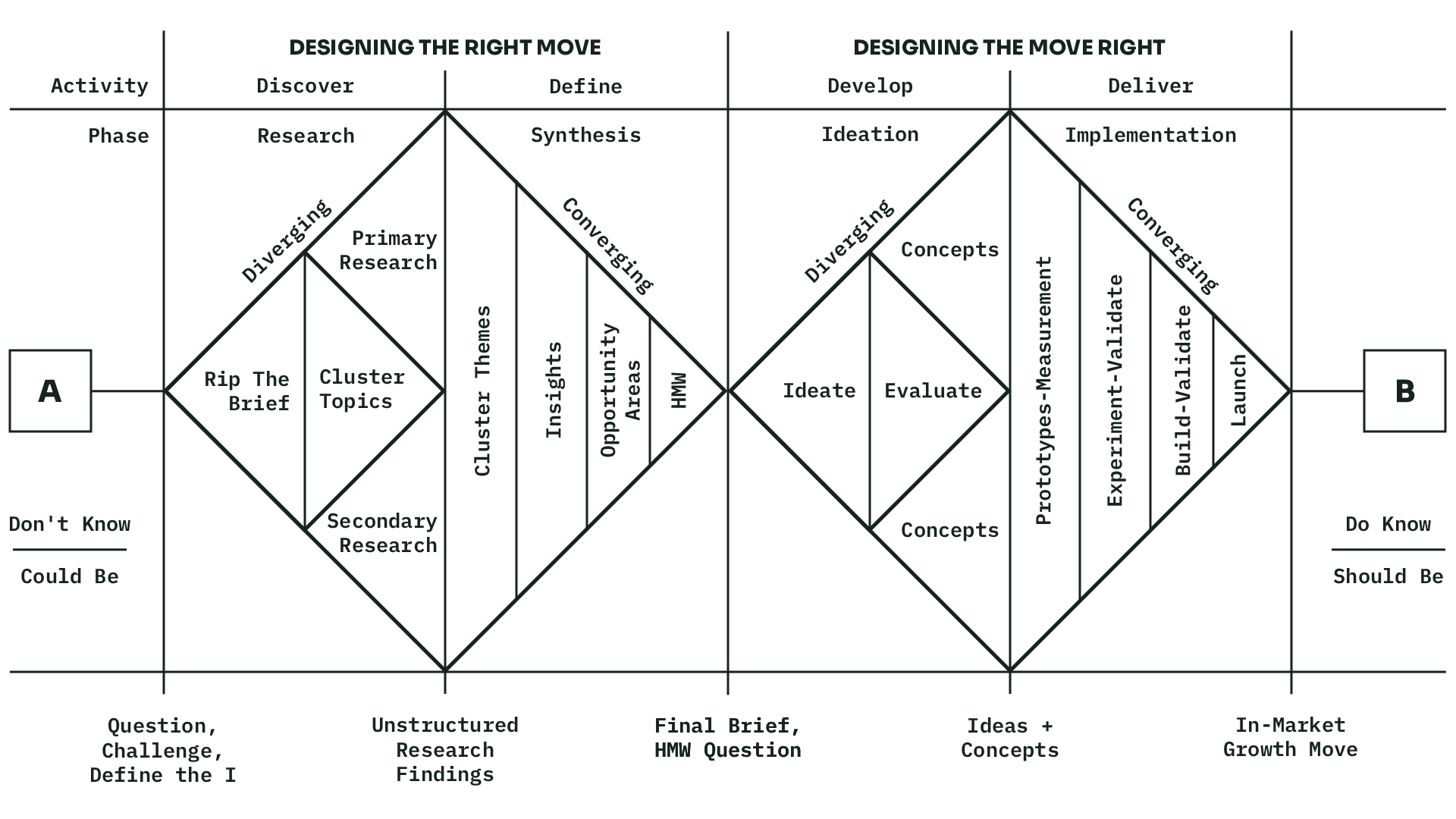
A human-centred design process, the double diamond, already does the job, with the gates built in that IV³ needs to work. It flexes to whichever I you started with, each enters the process at a different point and with a different weight of discovery and the V's govern every phase throughout.
The first diamond makes sure we're solving the right thing. The second makes sure we build it right.